For Name’s Sake

Mahin Banu’s Baby. Written in four vignettes, No. 3.

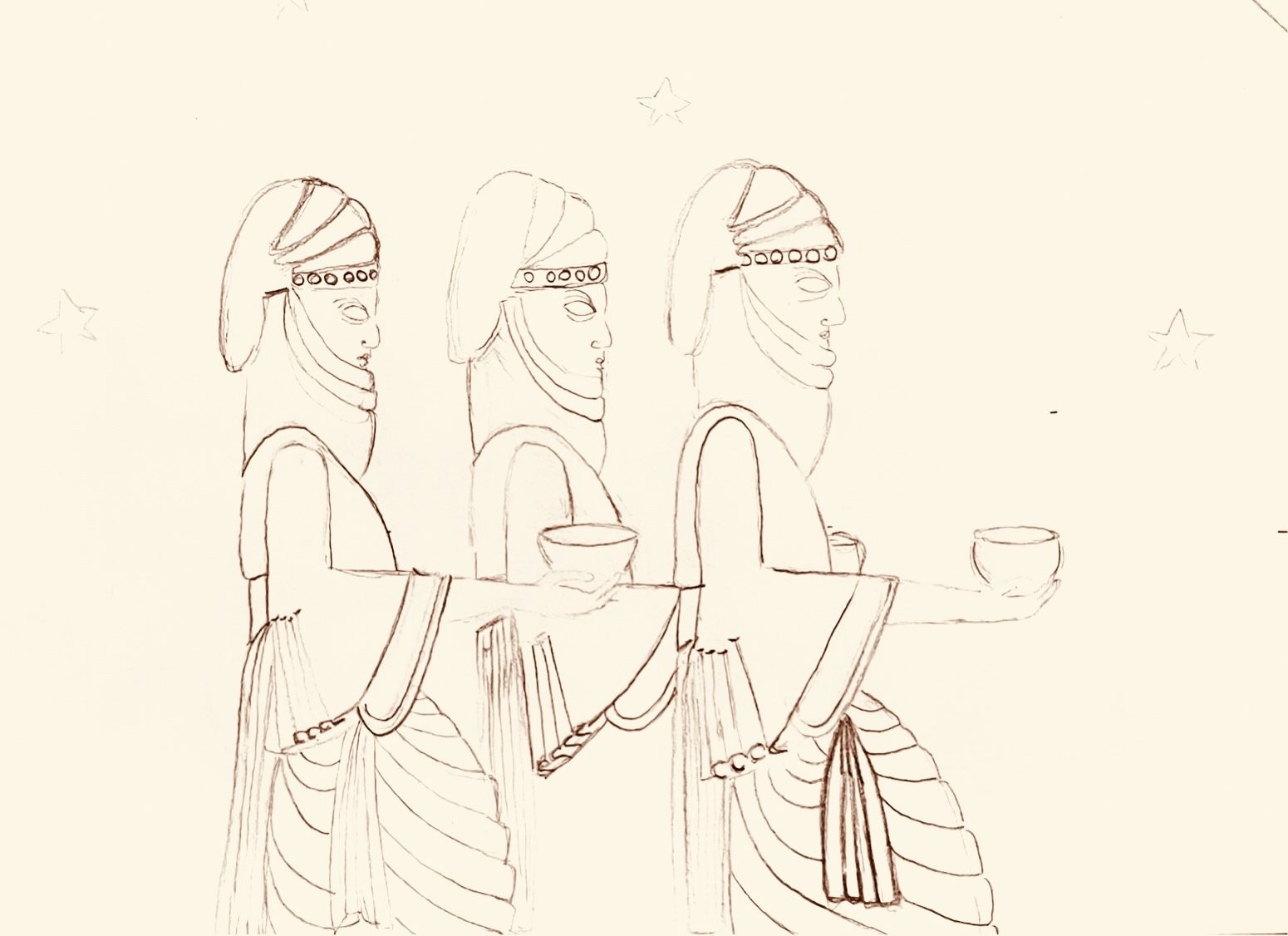
collage art by Alaleh Mohajerani [includes a photo of my mother eating yogurt (top) and my aunt (bottom) circa 1945; other citations in footnotes]

Every woman who married into the Moftakhar family was given a new name and a laqab, a descriptive title that replaced however unadorned a past a girl may have had in her father’s household, with the silver-threaded (albeit slightly moth-eaten) flourishes of her husband’s home. 

Over the years, as the young Moftakhar bride blossomed into womanhood, she learned how to carefully adjust her personality to fit her newly embroidered name.  She exposed previously veiled qualities – her knack for picking out quality fabrics, her passion for rose gardens and love poetry, her thick, black ringlets that she fashioned about her shoulders in new and innovative ways; and rushed to conceal traits which no longer suited her, burying her adolescence under layers of kohl and wearing long sleeves to conceal the fact that despite her feigned irreverence, the muezzin could still make the hairs on her arms stand on edge.  

Wherever there was room, she invented new truths. Tales of illustrious relatives who never existed; of heroic grandfathers and beauteous grandmothers, the evil cousin who had robbed her of some imaginary inheritance.

It was thus that the already crinkle-browed Ezzat lifted her chin an extra two inches, raised her shoulders an extra four, and assumed all the lofty airs of Ezzat El-Zaman; that the pious Batul dropped her black scarves and twirled in the antique, moonlit beauty of Mahin Banu; that the virginal Ozra ripened into the fertile splendour of Mehr Afaq; and that the slight, silent Fatemeh, hitherto hidden in the dimly-lit corners of her father’s home, boldly emerged into the fat, cackling sunbeams of Furuq Azam.

Asqar Aqa assumed that his own daughter’s name would also likely only be provisional, and so he hardly protested when the scrunched up man at the registration office said, “Zohreh?  That’s not a proper name.  You should give her a proper name.”

“And what, pray, do you consider a proper name, sir?”

“Well, I have a list right here,” said the clerk confidently. He took out a booklet with a handful of names scribbled inside.  “Let’s see.  There’s Belqeis, Fatemeh, Khadijeh, Sakineh, Kolsum–”

“Can’t you pick one?” said Asqar Aqa wearily. ”One name is as good as another.”  

“Hmmm. All right.  How about this one?”  He held up his booklet in the air.

Asqar Aqa rubbed the inner edges of his eyes with his thumb and forefinger, dragged the two fingers down around his mouth, focused on the page and winced.  “That one?  Really?”

“And why not?” dared the clerk, raising his eyebrows.  “You just said one name is as good as another.”

Asqar Aqa shrugged his shoulders and signed the registration papers, and was in fact rather pleased with himself. That is, until he came home later that evening and set the child’s papers before his mother.

“You named her what?”  His mother looked up from her Turkish coffee in disgust.  “You couldn’t find an uglier name for the poor child?”

“There was nothing I could do.  The man at the registration office was a pest.”

Khanum Bozorg handed her cup to her daughter, Heshmat, who turned it upside down on a saucer.

 “For God’s sake, Asqar,” said his sister coolly after a while, flipping the cup again and carefully studying the coffee grounds, ”we send you to do one thing and you come back with –  that?” She nudged at the papers that were sitting on the table.

“Well, maybe we can call her Zohreh at home?” suggested Asqar Aqa.

Khanum Bozorg waved him away and looked at her cup again. Heshmat was pointing to the rim. “You helped enough already. You and your Zohreh, Zohreh. Does that wrinkly little raisin look like a Venus to you?”

“Not really,” said Heshmat. ”I see the letter nun though.”

“I was talking about the baby,” said Khanum looking at her daughter over her spectacles. They both laughed.

Asqar Aqa sat beside his new wife, Mehri, who was examining her own cup. “I have a ye in mine! Or is that a snake?” She handed her cup to Heshmat.

“That’s a ye all right.” Her sister-in-law confirmed. 

“We’ll just have to find her a name that complements her sister’s,” said Khanum, picking up her embroidery work.

“And what, may I inquire, dearest mother of mine, complements Shuku?” said Asqar Aqa, bowing to his mother sarcastically.

“They’re all coming up letters today,” said Heshmat. ”I have a kaf in mine.” She passed her cup around. ”Either that or we are seriously lacking in imagination.”

Khanum Bozorg squinted her eyes in reflection and began muttering underneath her breath.  “Shuku, Shuku…no, no…Let’s see, we have Mahin Banu…” 

“Nun, ye, kaf,” said Heshmat. 

Nik, virtue,” said Mehri hopefully. “That’s a good sign isn’t it?”

“Not if you speak Arabic,” said Heshmat, showing off. She was a proud polyglot, and in her third year at university. She whispered the Arabic meaning in her sister-in-law’s ear and they both laughed.

Khanum smiled.  “I’ve got it!” she said, throwing down her work.  “Goodness, virtue.”

Asqar Aqa shrugged his shoulders at his wife.

“Niku!” hailed the three ladies at once, raising their coffee cups and cackling like a coven of witches.

Asqar Aqa picked up his hat and his papers off the table. “You three are scary,” he said, shuffling out of the room.

written by Alaleh Mohajerani

an earlier version of this text was first published by Cardiff University in 2008, and later featured in an anthology published by Cinnamon Press, entitled Black Waves in Cardiff Bay, also in 2008

collage citations: cup; embroidery

Leave a comment