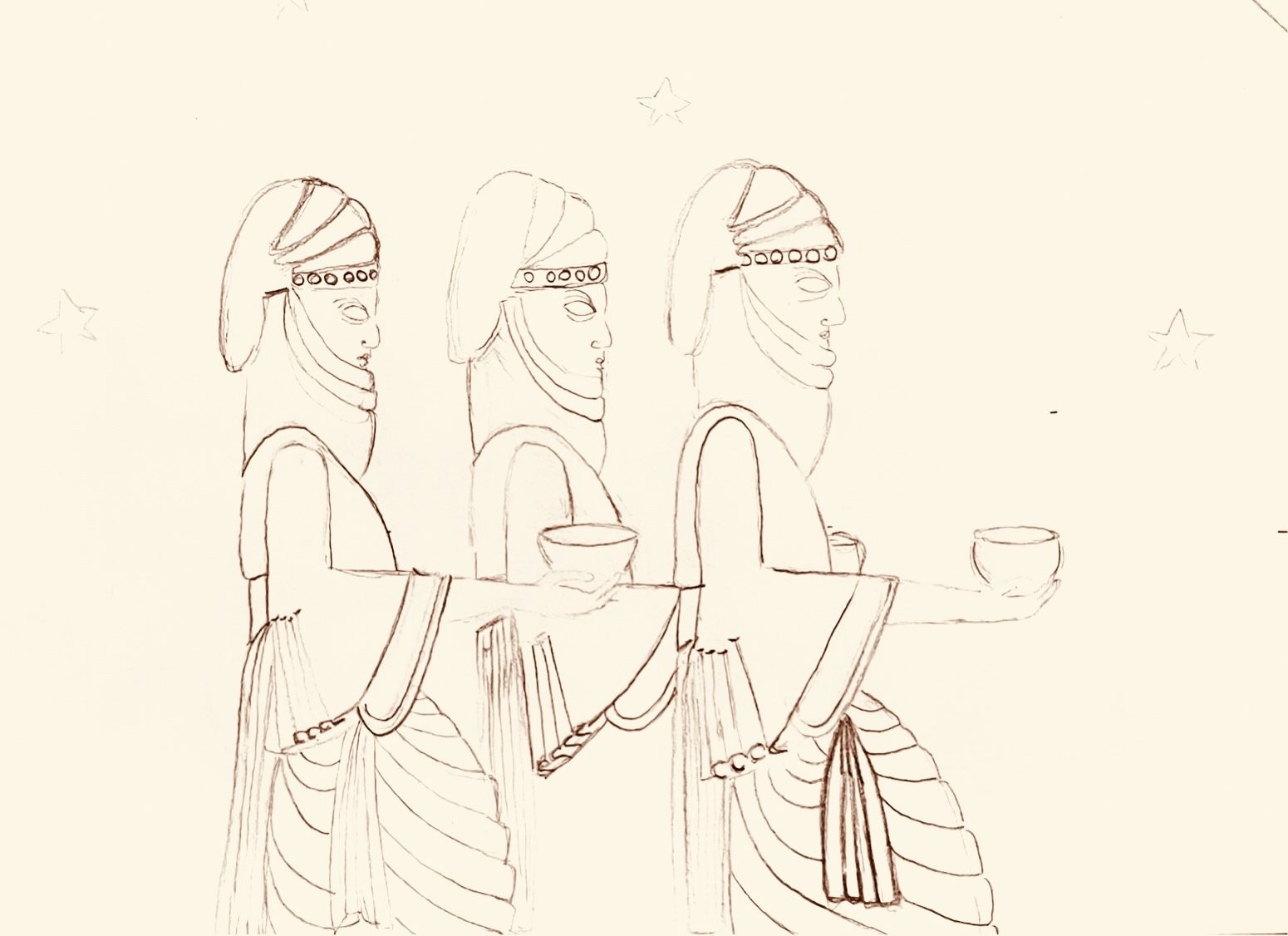
The story of my great-grandmother, Khanum Bozorg. Written in two vignettes, No. 1.

Before her three sons and three daughters gave her grandchildren, Khanum Bozorg was not Khanum Bozorg at all. She was Leila Mishmast and she was a “fire-whirl.”
At least that’s what her mother used to call her.
Her mother’s entire life revolved around the fact that she was the first cousin of Nasser Al-Din Shah Qajar, the fourth useless Qajar King of Kings in a long line of useless King of Kings. The dynasty’s crowning accomplishments included at least three major famines, humiliating territorial losses to both the Russian and British empires and sweeping economic and political concessions that eventually got old Nasser-ed-Din assassinated, and by 1925, the rest of the fabulously attired, albeit slightly fuzzy ilk, deposed.
Like many relatives of the monarch, and there were many, Leila was born and raised in the floral recesses of Golestan Palace. Leila’s father hailed from a Bakhtiari tribe linked to the Il of Arab-Mishmast who were moved to Tehran by Aqa Mohamad Khan Qajar when he first made the city his capital.
Now, it had long been accepted at court that Leila was no ordinary girl. Every morning, while the other young women her age were busy making love to their looking glasses, Leila was out riding her silver speckled horse around Dushan Tappeh. Every evening, while the others sat around their korsis, polluting the perfumed air with their cheap gossip, Leila had her nose nuzzled deep into one of Ferdowsi’s delicately painted tales. She spent most of her summers bathing, imagining herself as Esfandiar as he swam through the Spring of Invincibility with his eyes closed. She spent her winters practicing archery, envisioning herself then more as Arash, who in the name of his country, ripped out his noble heart and sent it flying with an arrow to eastern lands.
When she was fourteen, Leila met Ali Aqa Moftakhar. Ali Aqa was a regular at the Qajar court, and both he and his father before him, Qassim Moftakhar, worked in the offices of the darbar.
From an early age, Ali Aqa demonstrated a thieving, musical tongue for languages. He mastered five altogether and was eventually appointed as a dragoman in the royal translation department. But this was long before then. This was when Ali Aqa’s moustache was still at its blackest and his ears not quite so large. When he still rode his horse bareback through midnight thickets. When he died his first little death.
She was wearing her usual barberry-coloured velvet jacket and black riding boots. A slippery, mistreated headscarf dangled from her neck, revealing a large knot of straight brown hair. Although she had her back to him, Ali Aqa knew she was a beauty and that he would love her. Her strong, cypress-like figure quivered as she carved happily into a tree. Her black boots dug deeper and deeper into the fresh mud at her feet.
“I can feel you behind me, Ali Aqa,” she said suddenly, still etching away at what appeared to be some sort of calligraphy.
A little butterfly of silence fluttered along before Ali Aqa finally collected the courage to answer her back. “I’m sorry, have we met before?”
“Oh, I know who you are. You’re that Ali Aqa who’s always dashing about with your piles of books and your crumpled papers. I’ve seen you walking around my park talking to yourself.”
Ali Aqa blushed. “Your park? Excuse me, but I believe Baqeh Shah belongs to Ala Hazrat?”
“Everyone knows my cousin promised this park to me,” replied Leila nonchalantly. She waved him away dismissively, as if he were some well-read, moustached fly.
Ali Aqa dismounted to catch a better glimpse of the mouth that abused him so sweetly. “I’m sorry, I thought everyone at court had the right to come here. But if you say the park is yours, then I apologise for trespassing. Perhaps you would be so kind as to share your park with me?”
Leila cocked her head and examined him from the corner of her eyes. Faint traces of a smirk began to surface on her lips as she noted his sarcastic tone. Her dark eyes flashed through her long, messy fringe. Still, she gave no answer.
“Lei-la,” Ali Aqa finally read aloud, pretending to divert his attention to the engraving on the tree, and away from the scrutiny of the impish beauty that stood before him. “Leila is a good Arabic name. Leila – the night.” He took a deep breath. “Say, would you like to meet my horse, lovely Leila like the night?”
Leila’s interest was suddenly kindled. “Your horse? What’s his name?”
Ali Aqa quickly made up a name. He usually just called the old chap, “horse.”
“Er, Rakhsh, just like Rostam’s horse,” he lied.
“That’s not very imaginative,” frowned Leila. “But it’s a good name. I would like to meet him.”
Rakhsh had all the effect on Leila that Ali Aqa had hoped for. It was because of his fine silver Turkoman that Ali Aqa’s fingers first brushed against Leila’s long, tapered hands, and more importantly, that a series of horseback riding excursions commenced between the two youths, most of which were conducted in secret and very late at night.
Ali Aqa’s bulbul tongue was his second major asset. In English, he spoke of the shining lamps of Leila’s eyes; in French, of her laughter that spilled on the floor in thousands of unruly pearls; in Arabic, he sang of her chin that sheltered the sun in the dark hours of the night; and in Russian of her regal brow that reflected the moon even as they spoke.
Leila fell in love with Ali. Unfortunately for him, however, she also fell in love with another boy – a willowy, young officer by the name of Saftar Aqa. Saftar Aqa was a master equestrian, energetic and happy, but lacking in refinement. He told good jokes and smelled like oranges and tobacco, which pleased Leila well enough to love him and ride with him at night.
And so she traded off between the two. One night with Ali Aqa, one night with Saftar Aqa.
This continued for some time, until late one evening, when sneaking out of her apartment to meet Ali Aqa (or perhaps it was Saftar Aqa), Leila fell off her horse and broke her nose. Her mother, knowing exactly what her fire-whirl of a daughter had been up to the last several weeks, seized her by the ear.
“You were out with Ali Aqa again, I know it!” she cried. “This cannot go on, Leila. You cannot go horseback riding with Ali Aqa anymore!”
For the next few days, Leila stayed home under her mother’s steady watch. After a week, Ali Aqa, who was by now deeply in love with Leila and missed her to a point of exaggerated athleticism, came by and asked for her hand in marriage. Saftar Aqa came by the next day, with his candies and flowers and handwritten proposals.
Leila’s mother could hardly take any more. “You have two suitors, Leila,” she sighed, massaging her temples. She was weary of daughters in general and this one in particular. “Which one do you want? Saftar Aqa or Ali Aqa?”
“I want them both,” said Leila, chomping on an apple with a greedy innocence that could only make her mother smile.
Her mother shook her head. “You can’t have them both, my dear. Husbands are like horses. You can only ride them one at a time –”
“That’s not necessarily true. I heard of a khan from Khuzestan who could ride at least three ponies at once–”
“Hush you jinni spawn! Choose one and give me some peace!”
And Leila chose Ali Aqa.
Written by Alaleh Mohajerani
an earlier version of this text was first published by Cardiff University in 2008
collage citations: stars; Lotte Rheiniger; Qajar woman; Baqeh Shah

Leave a comment