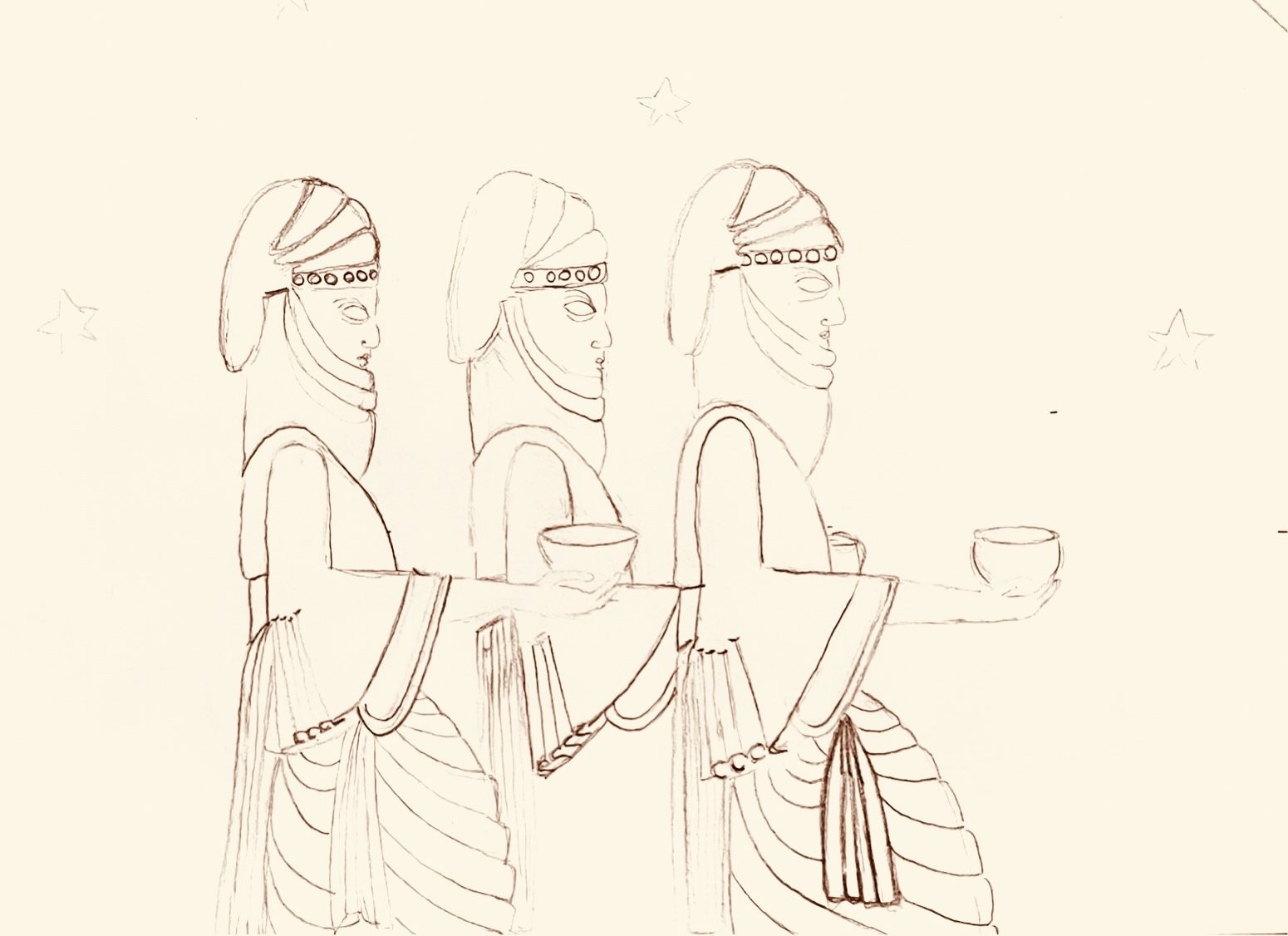
Mahin Banu’s Baby. Written in four vignettes, No. 2.

Mohtaram Khanum lived in Shahbdolazim, in the ancient city of Rey. Home to the shrine of Shah Abdol-Azim, Rey was reconnected to Tehran under Nasser ed-Din Shah Qajar by the Tehran-Rey railway, known affectionately by locals as the machine dudi, the “smoke machine,” and attracted masses of pilgrims every year, each with their own pocketfuls of prayers and fistfuls of wishes.
Mohtaram Khanum herself did not pray, did not wish. She was a hardworking, practical woman who from an early age had learned to accept the fall of her family’s fortunes, and all its ensuing mud and holes and meatless days, with an almost ascetic elegance.
She did not cry when her husband drowned late that last winter in the boiling pit that was the bath house khazineh, leaving her pregnant and alone with a litter of small children under a crumbling roof of poplar logs and straw-clay. Instead, she stuck pots and jars under each soggy spot and, having no radio or phonograph, listened to the mystic ghazals of the evening rain until the dry season. Nor did she cry when her baby died only a month after its birth. She watched the neighbours bury the newborn in silence and devised a plan to patch up the roof in the forthcoming months.
Rarely did any of Mohtaram Khanum’s wealthier relations visit Shahbdolazim. Her only regular visitors were her mother, Galin Khanum, who had been favoured by Nasser-ed Din Shah as a child and often entertained him with her dancing and theatrics when her parents were at court, and her mother’s sister, Shokat, who now worked as a cook in the Moftakhar house, and occasionally stopped by with food or money or word of some respectable work. But the Moftakhars themselves had yet to set foot in their forgotten cousin’s leaking abode. Until late one autumn evening, when Asqar Aqa appeared at her doorstep.
He brought the usual parcels of fruits and sweets that Mohtaram Khanum’s aunt would have delivered on such a visit, but a more peculiar parcel lay cradled in his arms.
Mohtaram Khanum invited her guest inside and offered him some of the tea and dates that he had brought along with him. She used her best tea set – clear, delicate glasses, each glazed with a faded golden rim – and assessed the brew in the sunlight, ensuring that it boasted the dark henna color of a good Persian tea. After some polite chit-chat over the general state of the family, a few brief but genuine mutual condolences, and some not-so-genuine cooing on Mohtaram Khanum’s part over what was essentially a weak, sickly-looking baby, Asqar Aqa finally laid out his offer.
“I will help you out in any way I can, Khanum,” he began, with a slightly uneven voice. “But it is I who am left at your mercy. My mother has been feeding this child sugar water for two days now. But she can not –” he choked a little, “she will not survive like this.”
If Mohtaram Khanum had been the praying type, she would have set off to Shah Abdol-Azim’s mirrored shrine that very day, showering his tomb in gratitude with her roof savings. But as she was not, she tucked her money into her blouse, took the baby in her arms, and once Asqar Aqa left, nursed her with what should have been her own baby’s milk.
For two years, Mahin Banu’s baby remained nameless in Shahbdolazim, under the care of Mohtaram Khanum. In these two years, she suffered every major disease that plagued the neighbourhood – chicken pox, measles, mumps, typhoid fever. She caught them all, and Mohtaram Khanum nursed her through them all, first by herself, and later with the help of an obliging jennet.
On Fridays, Asqar Aqa visited his daughter, taking care that the child’s wet nurses, both human and equine, never went hungry. At first he came alone, lugging bags filled with stone-baked bread, lamb and syrupy sweets for Mohtaram Khanum’s children. Two weeks later, he brought Mahin Banu’s youngest sister, Mehri, along with him. Three weeks later, the Samenis began urging the young widower to marry Mehri. Four weeks later, he did.
By the last time Asqar Aqa returned to Shahbdolazim, ready to welcome his daughter home, Mehri had already given birth to two children and was pregnant with her third. And of course, as fate would have it, all three of them were boys.
Though Mohtaram Khanum did not cry when Mahin Banu’s scrawny, dark child finally left her home, she did visit the Moftakhars twice a month for the next sixteen years, reminding them each time, “That’s my child. She drank my milk for two years.”
written by Alaleh Mohajerani
an earlier version of this text was first published by Cardiff University in 2008, and later featured in an anthology published by Cinnamon Press, entitled Black Waves in Cardiff Bay, also in 2008

Leave a comment