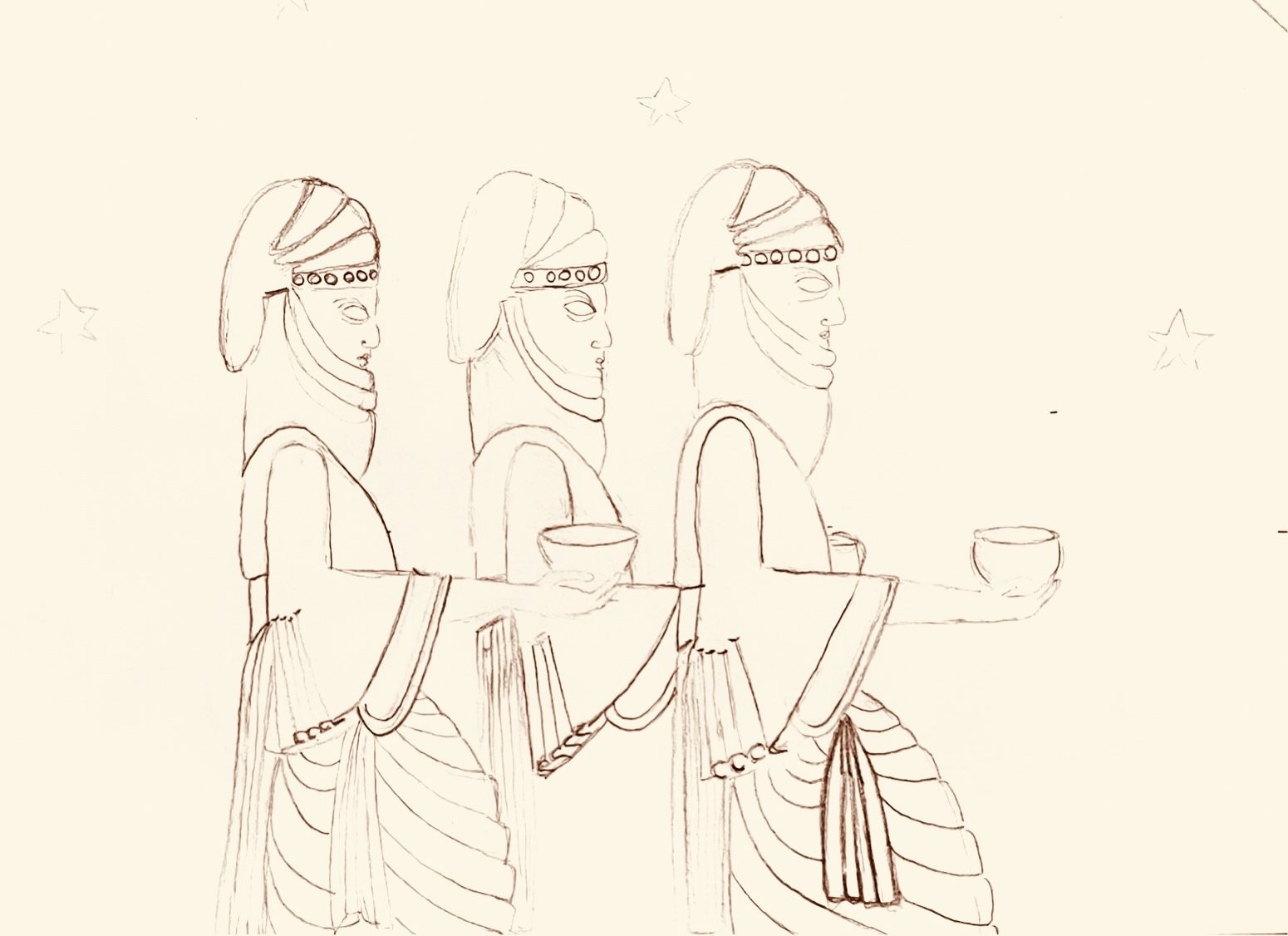
Mahin Banu’s Baby. My mother’s early years in 1940s Tehran. Written in four vignettes, No. 1.

Smoky silhouettes of Mahin Banu’s death lingered for some time in the Moftakhar household, acting and re-acting the events of that solemn day on the walls in a macabre shadow play. Aware of the chaos that was sure to ensue, Mahin Banu’s eldest sister, Badr al-Zaman, took it upon herself to hide the newborn baby in a safe place; some mute corner where she would not be stirred by the hordes of rocking mourners or passed along shaky, sobbing hands.
Looking very much like an ancient Egyptian embalmer with her oil lamp and rolls of gauze, Badr al-Zaman, cigarette in mouth, padded the baby with cotton, wrapped her up in a few sloppy layers of cloth fastened with bandages, and stowed the little mummy away in an oversized walk-in closet. The closet, lurking glumly in the remote, easternmost end of the house, was where the family kept its summer beds and blankets, extra linen, and the odd piece of broken furniture Asqar Aqa had been meaning to have fixed. A large korsi stood in the center of the room, stacked to the ceiling with a leaning tower of guest mattresses. On the pinnacle of this tower lay Mahin Banu’s baby.
Adhering to tradition, the Moftakhars and Samenis grieved for three unbroken days. Women who had barely met the deceased, beat themselves over the head and tore at their mourning clothes. Men in tweed vests puffed at their pipes and pontificated about fatalism and pre-destination. The middle-aged exchanged comforting clichés between mouthfuls of puff pastries, and the youth leaned quietly against the doorways and thought mostly of themselves – the young women terrified at the prospect of bearing children of their own some day, and the young men trying to recall the precise moment they had first set eyes on, and slightly fallen in love with Mahin Banu. The day she had passed by them in the market with her eyes fixed on her black suede heels perhaps, or the day she had served them tea at the Moftakhar house, with her enamel pendant dangling over her beautiful clavicle.
At the end of the third day, the murder of crowing mourners adjourned, leaving the immediate family to grieve alone until the seventh, at which time they would be sure to return with their empty bellies and bad advice.
As the last of the guests caravanned home, Asqar Aqa and his mother, previously occupied with the loss of Mahin Banu and the spectacles of funeral, suddenly realized they had not seen the baby in three days.
“God strike us down, where is the baby?” they cried, searching frantically around the house, while Badr al-Zaman was nestled at home under her own korsi, deep in a seventh sleep.
Resigning to the notion that the baby was lost forever, the family still continued its search despondently until morning, when Badr al-Zaman finally called.
“God have mercy on me!” she cried, tearing at her skin with her nicotine-stained fingers. “I left the baby on top of the korsi in the closet!”
Asqar Aqa was beside himself. “But we’ve pulled at least a dozen mattresses from in there, for all the guests!” he said, his eyes red from three days of mourning.
It was true. Every distant relative, far-flung acquaintance, and friendless neighbour who had come to pay their respects to the family, ended up staying at least one night at the Moftakhar home. And with each visitor, some housekeeper or boy servant or self-delegated welcome committee of irrelevant aunties, had set off to the closet and pulled a mattress out from the bottom of the cringing pile.
The family stampeded to the east end of the house.
“The little baby must have suffocated by now!”
“Poor baby, in there for three days! Poor thing must be dead!”
They surrounded the closet, which was looking a lot more jovial these days, and flung open its rickety door. Half a dozen mattresses were still piled up on the korsi. But no baby lay on top.
“She’s gone!” said Badr al-Zaman, sticking her lower lip out.
“Did somebody steal her?”
“Stand away from the light.”
“How could she disappear?”
“Perhaps her mother summoned her,” said Asqar Aqa miserably, tears welling up in his wilted eyes. He was neither religious nor inclined towards magical thinking, but had recently found himself in desperate need of such comforts.
“Don’t be ridiculous,” said his mother, pushing him aside. “Either somebody moved her or she’s still somewhere in this room.”
“Wait – over there in the back. What’s that over there?” someone called out.
“It looks like a pillow.”
“Oh, I think that’s mine,” a thieving neighbour insisted.
But it wasn’t hers. Behind the heap of mattresses, wedged in a four-inch space between the korsi and the wall, was Mahin Banu’s baby. Silent and poised, with ample patience to spare, the tiny bundle had been lying there in her makeshift incubator for three days. Her enormous obsidian eyes glared confidently at the stupefied Moftakhar family, who pulled her out and inspected her in the sunlight, among the mocking dust motes.
“Her destiny must be to stay in this world,” acknowledged one of the tweed-vested men generously. He placed his pipe in his mouth. “You should probably not let her die.”
Asqar Aqa’s mother laughed. It was the first laugh they had all heard in days and looked odd against the blackness of their clothes. She took the baby in her arms, gave her a dry, wrinkled kiss and said, “So, why is it that you want to stay in this world so bad, huh, you little dingleberry? Tell me, what is it that you plan on doing here, that you hang on to life with such tenaciousness?”
written by Alaleh Mohajerani
an earlier version of this text was first published by Cardiff University in 2008, and later featured in an anthology published by Cinnamon Press, entitled Black Waves in Cardiff Bay, also in 2008
collage art citations: star; black star; pearl; Qajar pendant; women in chador; Lotte Rheiniger; Lady in Walking Dress; smoke

Leave a comment